





The guide · Profitability and risks
Investing in a racehorse: the numbers, and the risks
A racehorse’s break-even point, calculated solely from the rates published by France Galop. Then the risks, without softening them.
- Prize money
- Premium
- Training fees
- Risk
75%
Share of a horse’s prize money that goes to its owner
France Galop, Becoming an Owner FAQ, accessed 16 October 2026
€1,500 to €3,000
Monthly training fees for a horse in training in France
France Galop, Becoming an Owner FAQ, accessed 16 October 2026
€15,000 to €30,000
Annual prize money needed just to cover training fees, for a 4-year-old born and raised in France
Calculation based on the rates published by France Galop
Winnings
Where a race’s prize money goes
Prize money, the sum put up for a race, is split twice at France Galop’s rates: between the placed horses, then between each horse’s connections.
The payout usually stops at fifth place, sometimes at seventh. Beyond that, a horse earns nothing and still costs the same every month.
- Between the placed horses: 50% to the winner, 20% to the second, 15% to the third, 10% to the fourth, 5% to the fifth
- Out of a horse’s share: 75% to the owner, 14% to the trainer, 8.5% to the jockey, 2.5% for social security charges
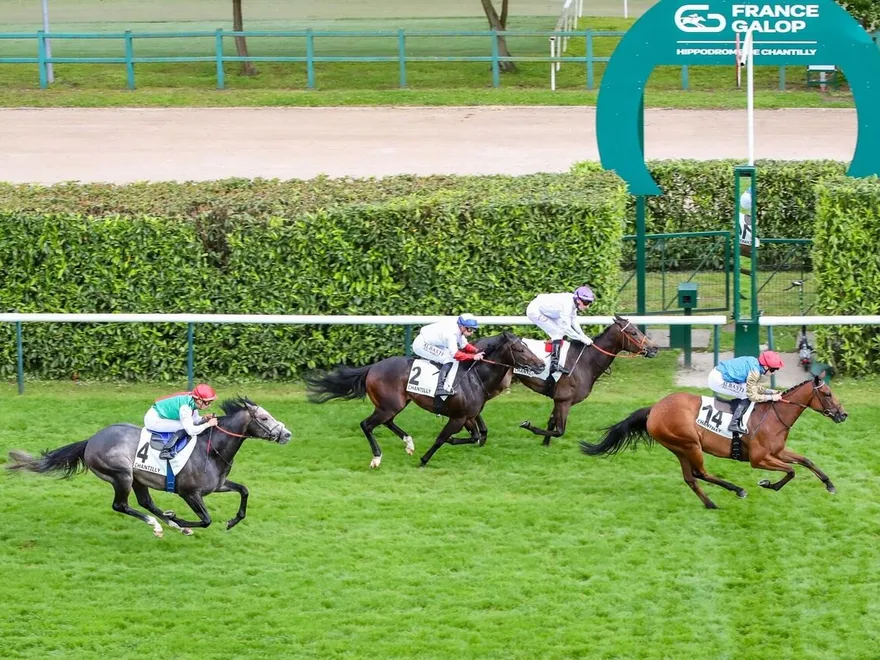
Born and raised in France
The owners’ premium, which lowers the break-even point
Paid by France Galop on top of prize money, for a Flat or jumps horse born and raised in France, or treated as such.
+75%
of prize money on the Flat, for 2- and 3-year-olds
France Galop, Becoming an Owner FAQ, accessed 16 October 2026
+45%
on the Flat, for horses aged 4 and up
France Galop, Becoming an Owner FAQ, accessed 16 October 2026
+33%
on the Flat, in Group 1 races
France Galop, Becoming an Owner FAQ, accessed 16 October 2026
+15%
over jumps, for fillies aged 3 to 5
France Galop, Becoming an Owner FAQ, accessed 16 October 2026
Break-even
What a horse has to earn just to pay its training fees
The annual prize money needed to cover training fees of €1,500 to €3,000 a month according to France Galop, or €18,000 to €36,000 a year. Arithmetic on published rates, not a forecast.
| Flat horse | What the owner receives | To cover €18,000 in training fees | To cover €36,000 |
|---|---|---|---|
| Born and raised in France, aged 2 and 3 | 75% of the horse’s share, plus a premium of 75% of the prize money | €12,000 | €24,000 |
| Born and raised in France, aged 4 and up | 75% of the horse’s share, plus a premium of 45% of the prize money | €15,000 | €30,000 |
| No owners’ premium | 75% of the horse’s share | €24,000 | €48,000 |
Calculation based on the rates in France Galop’s Becoming an Owner FAQ, accessed 16 October 2026. It covers training fees only: read it alongside the three caveats below.
Putting money into a racehorse is not an investment in the financial sense, and we will not present it as one. Here is the calculation, based solely on rates published by France Galop that you can check for yourself.
An owner receives 75% of the share of prize money that goes to their horse. On the Flat, a horse born and raised in France also qualifies, from the age of 4, for an owners’ premium of 45% of the prize money. To cover its training fees alone, €18,000 to €36,000 a year according to France Galop, that horse therefore has to earn €15,000 to €30,000 in prize money over the year, before any other cost and without paying off any of its purchase price. Yet prize money only rewards the first few home: a horse that isn’t placed earns nothing.
The three lines of income
1. Prize money. It is shared between the placed horses, then between the people involved, at the rates set out above. It is the only line that depends directly on results on the track.
2. The owners’ premium. Reserved for horses born and raised in France, or treated as such, it is paid on top of prize money. For the same result, a horse that qualifies therefore earns its owner more.
3. Resale value. A sale as a horse in training or for export, or a move to a breeding career. This is the most uncertain line: it only applies to some horses and depends on the level actually reached on the track, not the level hoped for at the time of purchase. As a benchmark, Arqana’s December 2025 Vente d’Élevage, the breeding stock sale where broodmares, foals and mares are sold, posted a median price of €28,000 for 666 horses sold.
The three lines of cost
1. The recurring cost of training. €1,500 to €3,000 a month in France according to France Galop, or €18,000 to €36,000 a year. For trotters, LeTrot publishes €25 to €50 excl. VAT per day, or €750 to €1,500 excl. VAT per month. This cost falls due every month, whether the horse wins, is injured or doesn’t race.
2. Additional costs. Farriery, vet, transport to the racecourse, entries, insurance if you take it out. LeTrot puts farriery at between €30 and €80 a month and entries mostly between €15 and €25 per race. The item-by-item breakdown is in our chapter on the price of a racehorse and its monthly cost.
3. Entry costs, paid once. The purchase price, the sale company’s fees (6% excl. VAT on top of the hammer price at Arqana), VAT, the pre-purchase vetting and the initial transport. On a horse knocked down for €30,000, the buyer’s fee alone comes to €1,800 excl. VAT.
Three caveats before reading the break-even table
First, the calculation in the table covers training fees only: no farriery, no vet bills, no transport, no entries, no insurance. It pays off none of the purchase price, the sale fees or the pre-purchase vetting.
Second, it assumes a horse born and raised in France. Without the owners’ premium, it takes €24,000 in prize money to cover €18,000 in training fees, instead of €12,000 to €15,000.
Finally, the decisive caveat: prize money only rewards the first few home. A horse that regularly finishes sixth in races that pay only five places earns nothing, while costing the same amount every month. The payout works as a threshold, not a smooth curve.
Sources
- France Galop, Becoming an Owner FAQ: monthly training fees of between €1,500 and €3,000, prize money split between the first five (50, 20, 15, 10 and 5%), split between owner (75%), trainer (14%), jockey (8.5%) and social security charges (2.5%), owners’ premiums for horses born and raised in France or treated as such, of 75%, 45% and 33% on the Flat and 15% for fillies aged 3 to 5 over jumps, tax regimes and the 36.2% rate on capital gains for non-involved owners, associations limited to 20 partners. French and English versions accessed 16 October 2026. france-galop.com
- LeTrot, Buying a trotter and what it costs: training fees of €25 to €50 excl. VAT per day, farriery of €30 to €80 a month, entries mostly €15 to €25 per race. Accessed 16 October 2026. letrot.com
- Arqana, buyer information: buyer’s fee of 6% excl. VAT on top of the hammer price. Accessed 16 October 2026. arqana.com
- Arqana, December 2025 Vente d’Élevage, Deauville: 666 horses sold, median price €28,000. Results reported by Racing Post and TrueNicks, 9 December 2025. truenicks.com
The break-even calculations in this chapter are arithmetic applied to the rates above. They are not a forecast, investment advice or a promise of returns.
The risks
Five risks, in the order they arise over a career
- 01
The horse never runs
The harshest: the purchase price and several months of costs lost, without a single line of form. A veterinary problem missed before the purchase is a classic cause, hence a pre-purchase vetting you cannot skip.
- 02
The horse runs below its cost
Sound, it races, but sometimes finishes outside the paying places. The costs keep coming, the winnings don’t. That leaves the hard decision: stopping.
- 03
Injury mid-career
It halts the winnings, not the costs: while convalescing, a horse costs its training fees without a racing programme.
- 04
Poor placing
Entered too high, a horse doesn’t get placed; too low, it doesn’t earn. This management risk is the one good racing stable management reduces most directly.
- 05
Liquidity
A horse sells when a buyer wants it, and public auctions are held on fixed dates. Without results, it rarely finds a buyer at its purchase price.
The levers
Three levers that reduce the risk
None of them produces a return.
- 01
Sharing ownership
France Galop allows up to 20 partners per association, with a manager approved as the owner of the colours. With the costs divided, you see the whole career through instead of stopping in month eight for lack of cash. The available structures: our chapter on becoming an owner.
- 02
Several horses
With shares in several horses, you are exposed to the average of a small portfolio rather than the fate of a single animal.
- 03
A horse born and raised in France
The owners’ premium lowers the prize money needed to cover training fees by several thousand euros (see the break-even table).
Tax
Your tax treatment depends on your involvement
France Galop distinguishes three situations, according to your actual involvement in running the horse. You do not choose yours.
| Situation | Prize money and premiums | Capital gain on sale | Losses |
|---|---|---|---|
| Non-involved owner | Exempt from income tax | Taxed at an overall rate of 36.2%, after a 5% allowance for each year of ownership beyond the second | Cannot be offset |
| Involved, non-professional owner | Taxed as non-professional non-commercial profits (BNC) | Short-term and long-term capital gains regime | Can be offset only against income of the same kind, for six years |
| Professional owner | Taxed as professional non-commercial profits (BNC) | Long-term capital gains taxed at an overall rate of 30% | Can be offset against profits of the same kind, then against total income |
Source: France Galop, Becoming an Owner FAQ, French and English versions, accessed 16 October 2026. These regimes govern how winnings, capital gains and losses are taxed; they do not turn buying a horse into a tax-free investment. Have your situation assessed by a tax adviser before you buy.
Our position
A racehorse is not a financial investment.
A well-advised owner thinks in terms of controlled cost rather than expected return.
Frequently asked questions
Profitability, winnings and risks: your questions
Is it profitable to own a racehorse?
There are no grounds for promising that. Prize money only rewards the first few home, usually the first five, while the costs come every month. On the rates published by France Galop, a 4-year-old Flat horse born and raised in France has to earn €15,000 to €30,000 in prize money a year just to cover its training fees, without paying off any of its purchase price.
How is prize money shared out in a race?
In two stages, at rates set by France Galop. First between the placed horses: in most races, 50% of the prize money to the winner, 20% to the second, 15% to the third, 10% to the fourth, 5% to the fifth. Then, out of a horse’s share, between the people involved: 75% to the owner, 14% to the trainer, 8.5% to the jockey, 2.5% for social security charges.
What is the owners’ premium in France?
A sum paid by France Galop, on top of prize money, to the owner of a Flat or jumps horse born and raised in France, or treated as such. On the Flat: 75% of prize money at 2 and 3, 45% at 4 and up, 33% in Group 1. Over jumps: 15% for fillies aged 3 to 5. It improves the break-even point without covering the cost of ownership alone.
How do you assess a horse’s profitability before buying?
By working out the break-even point before you look at the horse, from three figures: the annual training fees you are prepared to carry, the owners’ premium rate for the horse’s age and discipline, and the prize money in the races the horse can realistically run in. Those races must be able to cover the training fees. If the sums fail on paper, no pedigree will make them work.
Should a racehorse be called an investment?
Only if the word doesn’t suggest an expected return. A racehorse is a sporting asset whose value depends on future performance, with a risk of total loss and no mechanism of any kind to protect your capital. No one can promise you a return on a horse.
What are the financial risks of owning a racehorse?
There are five main risks: the horse never runs, often for veterinary reasons; it runs without being placed; an injury interrupts its career without interrupting the costs; its racing programme is poorly pitched; and it finds no buyer when you want to get out. Sharing ownership and spreading it across several horses reduce your exposure without removing any of these risks.
Further reading
Budget, ownership, management
- The price of a racehorse
The purchase price and the monthly cost, item by item.
- Becoming an owner
Approval, forms of ownership and sharing.
- Flat, trotting, AQPS, jumps
Entry price, training fees and premiums, discipline by discipline.
- Racing stable management
Race planning, trainers, jockeys: reducing the management risk.
- Selling a racehorse
Valuing, presenting and selling a horse, at auction or privately.
- Our case studies
Documented assignments, with their figures and their sources.

Thinking of becoming an owner?
Let’s cost the project before the horse
Tell us your purchase budget and the annual budget you are prepared to carry: we look for the horse that fits them.
- Agency founded in 2018
- More than 1,700 horses sold in 32 countries
- No promise of returns